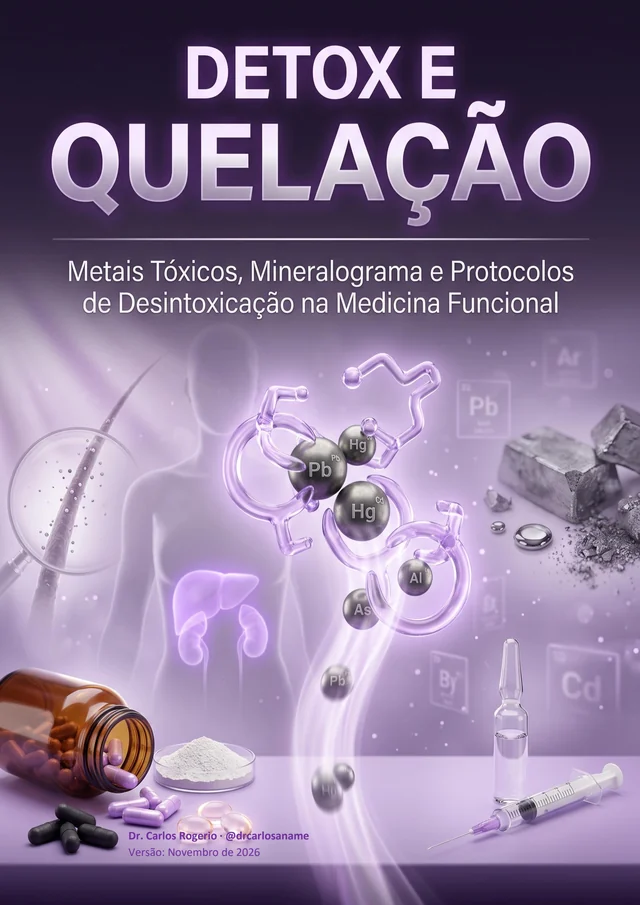

Cover of the e-book Detox and Chelation: toxic metals, hair mineral analysis and detoxification protocols in functional medicine.Coming soon

PDF e-book · 57 pages · Dr. Carlos Rogerio

Detox and
Chelation

The same hair sample, sent to six US laboratories, came back with differences of more than 10-fold in 12 minerals. A high metal on a hair mineral analysis is not, on its own, an indication for chelation. This e-book goes from exposure to treatment: the 21 metals, how to collect and read a hair mineral analysis, the test that confirms each metal and the chelators, from intravenous to oral options, with dose, safety and evidence.

  • 21 metals: sources, signs, the right test and approach
  • Hair mineral analysis: collection, the six steps of interpretation and the patterns
  • EDTA, DMSO, MSM, DMSA, DMPS and oral options, with dose and safety

The English edition is coming soon

Tap "Notify me" and send the ready-made WhatsApp message: we will let you know when the English edition is out.
Intended for health professionals. Patients and the general public can also buy it.

What almost no one tells you
about heavy metals and chelation.

In groups and in clinics, metal detox often starts with a hair test report and ends with an IV drip. These are six points the e-book takes apart, each with the source for what is claimed and the module where the topic is covered in detail.

  • 01Modules 4 to 6

    "Metal showed up on the hair mineral analysis, so it calls for chelation"

    It does not. A hair sample from a single volunteer, split among six US laboratories, came back with differences of more than 10-fold in 12 minerals (Seidel, JAMA, 2001). Hair dyes, straightening treatments and shampoos also change the result. The e-book shows how to recognize a contaminated sample and which test confirms each metal before any course of action.

  • 02Module 6

    "A provoked urine test proves metal toxicity"

    The American College of Medical Toxicology has stated that the test has not been validated: the chelator increases urinary metal excretion even in people with a normal body burden, and there are no reference values for provoked urine. For follow-up, the e-book points to the validated test for each metal, such as venous blood lead.

  • 03Module 14

    "Activated charcoal removes heavy metals"

    Activated charcoal does not adsorb most metals: poison control centers advise against using it for lead, iron and lithium. The exception is thallium, as an adjunct to Prussian blue. Zeolite increased urinary metal elimination in small studies, but there is still no large study with a clinical outcome.

  • 04Module 9

    "All EDTA is the same"

    It is not. Calcium disodium EDTA does not chelate calcium in the blood; disodium EDTA does, and when infused rapidly it causes hypocalcemia. In 2006, the CDC reported three deaths from hypocalcemia during EDTA chelation; in two of them, children received disodium EDTA instead of calcium disodium EDTA. The recommendation: check the chemical form before every infusion.

  • 05Module 16

    "Chelation cleans out the arteries"

    The first large trial, TACT, with 1,708 patients after a heart attack, showed a modest reduction in events: 26% in the chelation group versus 30% in the placebo group. TACT2, designed to confirm the finding in patients with diabetes, lowered blood lead, but not cardiovascular events. The e-book shows what this evidence allows us to say and what it does not.

  • 06Module 14

    "Alpha-lipoic acid is a mercury chelator"

    For mercury, the dimercapto chelators (DMSA and DMPS) are the treatment of choice. Alpha-lipoic acid has a limited ability to reduce the metal, and its metabolite, DHLA, increased the effects of mercury on glutathione in human cells. In the e-book, it appears as an antioxidant and mitochondrial protector, with the source removed and with glutathione and selenium support.

The e-book does not teach anyone to do chelation on their own. Chelators are drugs with real risks, and indication, prescription and monitoring are the responsibility of a licensed health professional. What it delivers is the complete reasoning, from exposure to the choice of chelator, with what has clinical trials behind it kept apart from what is clinical tradition.

From exposure to treatment,
in the right order.

The three parts follow the sequence of practice: understand where the metal comes from and how it harms the body, investigate with a critical eye and only then assess the therapeutic tool.

Clinical pearl

In functional practice, the safest sequence is usually: remove the source, correct minerals and antioxidants, optimize glutathione and only then consider pharmacological chelators, when there is a confirmed indication.

How the boxes appear in the e-book (module 14)
01
Part 1 · modules 1 to 3

Toxic metals: the 21 metals in the source book, one by one

Where each metal comes from, what it does in the body and how it shows up in the clinic.

  • The mechanisms of toxicity: enzyme inhibition, cofactor substitution, membrane damage and the affinity for sulfhydryl groups
  • The big five, lead, mercury, arsenic, cadmium and aluminum, with sources, manifestations, tests and approach
  • Blood lead according to the CDC: in children, 3.5 µg/dL is a marker for action, and there is no safe level
  • Iron, copper, manganese, nickel and 12 more metals, from antimony to the uranium in Brazil's reserves
  • The summary table: sources, targets, nutritional support and the chelator cited for each metal

02
Part 2 · modules 4 to 6

Hair mineral analysis and tests: investigate before treating

What hair shows, what it does not show and which test confirms each metal.

  • Collection: stainless steel scissors, the occipital region, the 3 cm closest to the scalp and what to avoid
  • The six steps of interpretation, the Ca/Mg, Ca/P and Na/K ratios and the elements that "dance together"
  • The contamination markers: nickel from 0.4 µg/g already suggests a contaminated sample
  • The hair mineral analysis patterns, from cosmetic contamination to cardiac risk, as hypotheses to be confirmed
  • The reference test for each metal and the decision flow when metal toxicity is suspected
03
Part 3 · modules 7 to 15

Chelation: from IV to oral options

Every chelator in the same template: chemistry, mechanism, the package insert dose and the source book dose, safety and contraindications.

  • EDTA: the three forms, the affinity gradient, the source book protocol and the TACT trial protocol
  • DMSO and MSM: reported uses, dosage and what current literature adds on safety
  • DMSA, DMPS, D-penicillamine and deferoxamine, with the package insert dose and the source book dose side by side
  • Oral options: alpha-lipoic acid, zeolite, activated charcoal and seven nutritional chelators, with what each one does
  • The checklist before starting, the choice of chelator by metal and the mistakes that must not happen

57 pages in four parts.

From the problem to the treatment: toxic metals, detection through hair mineral analysis and tests, chelation and a supplement with the modern evidence, the critical notes on the source text, frequently asked questions and the references. Every claim carries its evidence label.

Part 1

Toxic Metals

Sources of exposure, mechanisms of toxicity and the main metals, one by one.

  1. Mod. 1Toxic metals: fundamentals
  2. Mod. 2The big five: lead, mercury, arsenic, cadmium and aluminum
  3. Mod. 3Other metals and minerals in excess

Evidence labels · Table 2

[BQ]
Established biochemistry and pharmacology
[ECR]
Published randomized controlled trial
[REG]
Package insert or regulatory agency document (FDA, CDC, ATSDR)
[EM]
Mechanistic extrapolation or preclinical study
[TC]
Clinical tradition and experience reported in the source book
[CI]
Contraindicated by existing evidence

Part 2

Detection: Hair Mineral Analysis and Tests

Collecting and reading the hair mineral analysis, interpretation patterns, limits of the method and validated tests.

  1. Mod. 4Hair mineral analysis: collection and reading
  2. Mod. 5Interpretation patterns of the hair mineral analysis
  3. Mod. 6Limits of the method and complementary tests

Part 3

Chelation

Guide for patients, fundamentals, EDTA, DMSO, MSM, dimercapto chelators, D-penicillamine, deferoxamine and nutritional chelators, and safety.

  1. Mod. 7Chelation in plain language: a guide for patients
  2. Mod. 8Fundamentals of chelation
  3. Mod. 9EDTA (ethylenediaminetetraacetic acid)
  4. Mod. 10DMSO (dimethyl sulfoxide)
  5. Mod. 11MSM (methylsulfonylmethane)
  6. Mod. 12Dimercapto chelators: DMSA and DMPS
  7. Mod. 13D-penicillamine and deferoxamine
  8. Mod. 14Oral chelation, intestinal binders and nutritional chelators
  9. Mod. 15Safety, monitoring and choice of chelator

Part 4

Advanced Supplement

Modern evidence, critical notes on the source text, frequently asked questions and references.

  1. Mod. 16What the modern evidence says
  2. Mod. 17Critical update notes on the source text
  3. Mod. 18Frequently asked questions
  4. Mod. 19Scientific references

Written for those who prescribe and for those who will be treated.

The e-book is intended for health professionals, but patients and the general public can also buy it. The professional finds mechanism, indication, contraindication, the dose described in the literature and monitoring; the patient finds the same information in plain language, in the "For the patient" boxes and in Module 7, and arrives at the appointment knowing what to ask.

Health professionals

In functional and integrative medicine, within the scope of their legal competencies, who need to investigate metals with a critical eye and manage chelation safely.

  • The validated test for each metal and what hair mineral analysis can and cannot show
  • The package insert dose and the source book dose side by side, with contraindications and monitoring
  • The critical notes: the points where the 2015 source text was corrected by a more recent source
  • The checklist before starting, the choice of chelator by metal and the mistakes that must not happen

Patients and the general public

Who want to understand what chelation is, what it is for and what it is not for, before starting or during treatment.

  • Module 7, chelation in plain language, and the "For the patient" boxes throughout the e-book
  • Why an abnormal hair mineral analysis is not enough to indicate chelation
  • What you may feel during the infusion and the signs to report to the team right away
  • The six questions to ask your health professional before starting

Intended for health professionals. For patients and the general public, the e-book is a way to understand the treatment: it is not a prescription, it does not replace a consultation with a licensed professional, and chelators should not be used on your own.

The complete e-book
coming soon in English.

The English edition is in preparation. Leave your request and we will message you on WhatsApp when it launches.

Cover of the e-book Detox and Chelation: toxic metals, hair mineral analysis and detoxification protocols in functional medicine.Coming soon

AuthorDr. Carlos Rogerio@drcarlosanameNovember 2026 edition

What you get
  • 57-page PDF e-book with 19 modules in 4 parts
  • The 21 metals in the source book: sources, mechanisms, manifestations, tests and approach
  • Hair mineral analysis: collection, the six steps of interpretation, the patterns and the contamination markers
  • The right test for each metal and the decision flow when metal toxicity is suspected
  • EDTA, DMSO, MSM, DMSA, DMPS, D-penicillamine and deferoxamine, with the package insert dose and the source book dose
  • Oral options: alpha-lipoic acid, zeolite, activated charcoal and nutritional chelators
  • 24 tables, 9 original figures, the critical notes on the source text, frequently asked questions and 36 references
PDF pages
57
modules in 4 parts
19
tables
24
scientific references
36
metals, one by one
21

Every claim carries its evidence label ([BQ] [ECR] [REG] [EM] [TC] [CI]), and what comes from the clinical tradition of the source book, marked as [TC], is kept apart from what has a clinical trial or package insert behind it. Where current literature diverges from the source text, an update note shows the divergence.

The English edition is coming soon

Tap "Notify me" and send the ready-made WhatsApp message: we will let you know when the English edition is out.

Frequently asked
questions

If yours is not here, write to contato@basefuncional.com.

Dr. Carlos
Founder and CEO

Dr. Carlos

@drcarlosaname

Biomedical scientist, specialist in functional medicine and nutrition.

With a postgraduate degree in Aesthetic Biomedicine, he furthered his studies in Nutritional Adequacy and Maintenance of Endocrine Homeostasis: Prevention and Treatment of Age-Related Diseases, by Dr. Lair Ribeiro.

He starts from functional physiology and biochemistry to understand each patient. In metabolic health, he reads epigenetics and metabolism to reach the origin of the imbalance. In aesthetic biomedicine, he treats beauty as a reflection of health. In bio-oxidative and regenerative therapies, he works with the body's own capacity to regenerate. In everything, the same principle: investigate the cause before treating the symptom.

At Base Funcional, he brings together in one place the apps, courses and e-books that take functional medicine from investigating the cause to the daily routine of the practice.

From hair mineral analysis to chelator,
with the right test before each step.

Notify me

57 pages, 19 modules and 24 tables, coming soon in English.